
The Observation
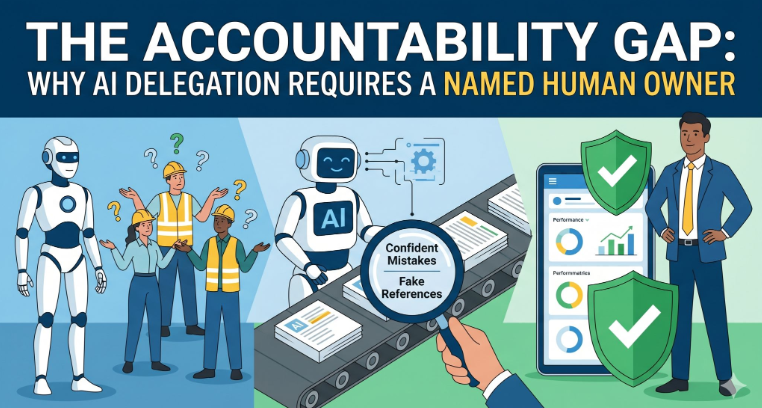
I'm seeing too many executives treat AI like a plug-and-play replacement for headcount. It is a dangerous play. When you yank the human out of the loop, you lose the only safety net capable of catching confident hallucinations and fake data. AI doesn't care about legal liability or organizational fallout. If there isn't a clear name attached to the final output, accountability just evaporates into the noise.
The Analysis
AI can dump massive datasets in seconds, but that speed is a trap. Generation is cheap; validation is expensive. Reviewing machine output isn't a passive task, it's a hunt for hidden landmines that requires deep, lived expertise. If you aren't explicitly budgeting hours for human review, your best people will become a permanent bottleneck. Even worse, human intuition is a use it or lose it asset. If your team stops wrestling with the work and just starts rubber-stamping the machine, their skills will silently rot.
The Technical Step
You have to shift how you view delegation in a high-velocity environment. We need to move past the AI Expert fluff and get back into the trenches with strict accountability.
Named Human Owner: every single output needs an assigned owner before the prompt even runs. Their name is on the line. They take the hit if it fails.
Budget for Validation: stop planning sprints based on how fast the LLM spits out text. Factor in the gritty time required for a human to verify every claim.
Prevent Skill Decay: force periodic human-only cycles. Your team has to stay sharp enough to know when the machine is lying to them.
Question for the network
Are you actually assigning a human soul to your AI work, or are you just letting accountability bleed out?
References
- HAIF: A Human-AI Integration Framework for Hybrid Team Operations (2026)
By Michael Lennard Gnaedinger. © 2026 Gnaedinger Consultancy. All rights reserved.
If any of this sounds familiar.
I work with a small number of founders and CEOs each year. The conversation starts here.