
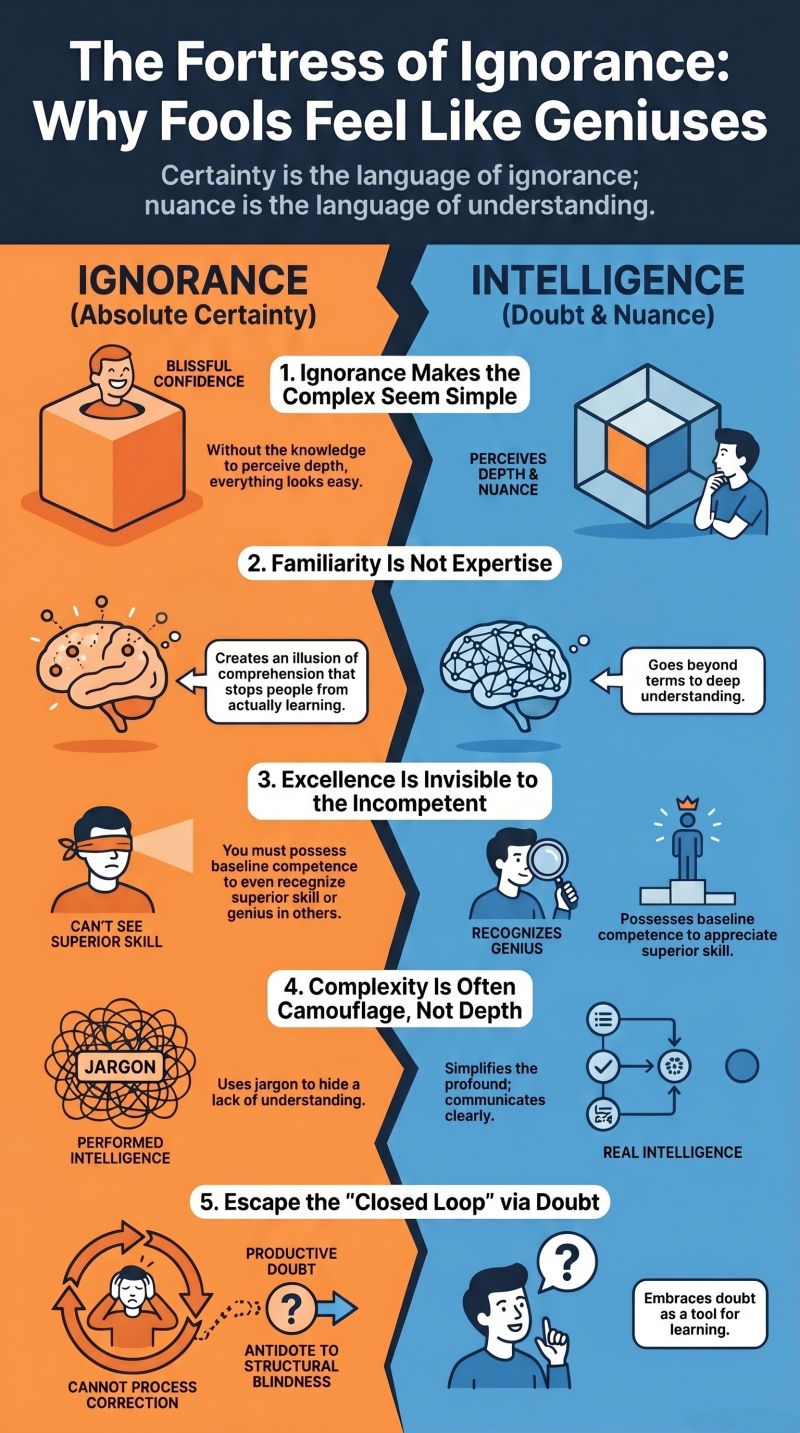
Have you ever found yourself in an argument with someone who has no expertise and no evidence, yet speaks with absolute, unwavering certainty?
We often talk about the Dunning-Kruger effect, but the relationship between ignorance and confidence is an old observation. Charles Darwin noted that ignorance more frequently begets confidence than does knowledge. Decades later, Bertrand Russell observed that the fundamental trouble with the world is that the stupid are cocksure while the intelligent are full of doubt.
Intelligence creates doubt. Ignorance creates certainty. Here is how confident ignorance operates, and how to avoid the trap.
The Illusion of Simplicity
True understanding requires the ability to perceive complexity, which requires foundational knowledge. If you lack that baseline, a subject looks remarkably simple. This creates a state of blissful confidence born entirely out of an ignorance of how much you actually do not know.
The Illusion of Comprehension
Passive familiarity is often mistaken for active expertise. Hearing buzzwords and following conversations can make you assume you understand a topic deeply. But knowing about something is not the same as knowing it. Before speaking confidently, ask yourself: Could I teach this to someone else? Could I defend it against expert counterarguments?
Complexity as Camouflage
Not all confident ignorance is simple. Sometimes people use elaborate jargon and big words to sound profound, using complexity as a substitute for depth. If you cannot explain a concept in simple terms, you do not understand it well enough. More often than not, complexity is just confusion dressed up as sophistication.
The Closed Loop
Correcting confident ignorance is difficult because correction requires a person to perceive the gap between their belief and reality. If someone lacks the competence to process the evidence you present, they will dismiss it or reinterpret it to fit their existing framework. They are trapped in a cycle they cannot break from the inside.
The Antidote: Productive Doubt
To ensure you are not the confident fool in the room, practice productive doubt. Ask yourself regularly: Am I sure about this? What might I be missing? What evidence would actually change my mind?
The wisest approach is to remain aware of how much you do not know.
By Michael Lennard Gnaedinger. © 2026 Gnaedinger Consultancy. All rights reserved.
If any of this sounds familiar.
I work with a small number of founders and CEOs each year. The conversation starts here.