
I previously published an overview piece ranking the biggest company in the world by revenue, decade by decade, from 1900 to today. This is article two of a thirteen part series digging into each one properly.
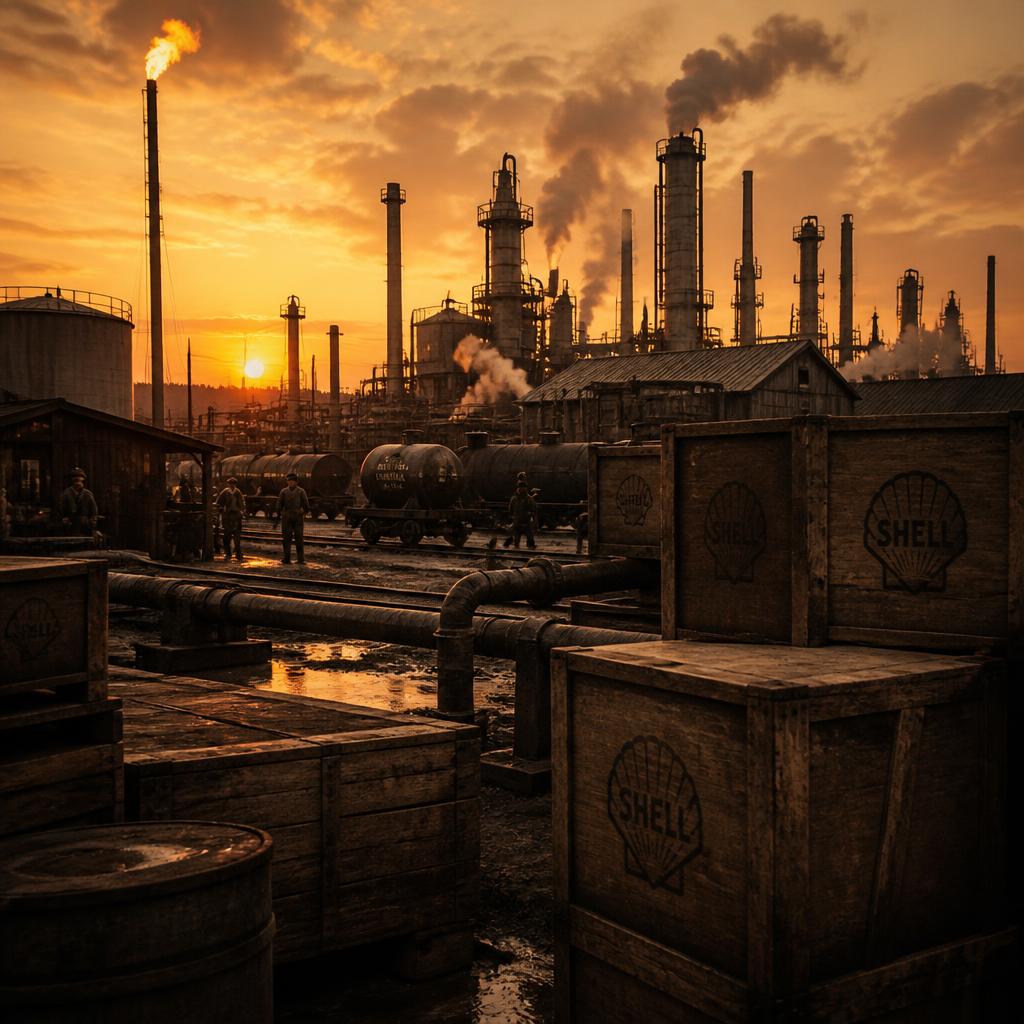
Marcus Samuel started out selling boxes decorated with seashells. By the 1890s he had built one of the world's first oil tanker fleets and named his company after the family trade. By 1901 he was Lord Mayor of London. Then he made one bet that nearly ended everything.
Texaco struck a huge gusher at Spindletop in January 1901. Samuel agreed to buy the oil, betting on a steady flow. The well slowed, then stopped entirely by the summer of 1902. Shell Transport's finances never recovered from the hole that left.
Enter the bookkeeper
Henri Deterding joined Royal Dutch Petroleum in 1896 as a 30-year-old bookkeeper. By 1901 he was running the company. He watched Shell Transport weaken for five straight years, and by 1906 he did not need to negotiate. He could dictate. The 1907 merger gave Royal Dutch 60 percent of the combined group. Shell Transport got 40. Samuel, according to the people who documented it at the time, had no choice but to accept. The man whose name was on the company was no longer the one calling the shots.
This is worth sitting with for a second. Shell did not become the giant it is today because its founder had a brilliant strategic vision for global domination. It became a giant because a rival company's finances collapsed at exactly the wrong moment, and a former bookkeeper was patient and financially disciplined enough to be standing there when it did.
Then Deterding did something Gary never would have
If you read the previous piece in this series, you will remember Elbert Gary took over U.S. Steel and chose stability. He called competition immoral. He coordinated prices with rivals instead of fighting them.
Deterding took the opposite path entirely. Once he had control, he expanded hard and fast, directly into enemy territory. Between 1906 and 1914 he secured production interests in Romania, Russia, Egypt, Venezuela and Trinidad. In 1912 he set up Roxana Petroleum to drill in Oklahoma, on American soil, going after Standard Oil's own domestic market. A year later he bought into California.
By the end of 1915, Royal Dutch Shell was pulling almost six million barrels of crude a year out of American ground alone. He was not just building a rival to Standard Oil. He was invading its home turf while Rockefeller's people were still figuring out what had happened to their weakened old competitor Shell Transport.
The number that mattered
By 1920, Royal Dutch Shell had overtaken Standard Oil as the largest oil producer in the world. Total assets for the combined group had grown more than two and a half times between 1907 and 1914 alone. A company built from the wreckage of one disastrous Texas bet was now bigger than the most feared corporation in America.
What actually happened here
Two things had to be true at once for this to work. Shell Transport had to get weak enough for Deterding to take control on his terms, and Deterding had to be disciplined enough, and bold enough, to actually use that control aggressively once he had it. Most acquirers in that position play it safe. They just want to stabilise the mess they inherited. Deterding stabilised nothing. He used a wounded company as the base to invade the territory of the biggest player in the industry, and he had it done within thirteen years.
Question for the network
If you are ever the one taking control of something that has been through a rough patch, that is the real lesson here. Fixing what is broken is the minimum, not the ambitious move. The real opportunity is usually sitting one step past that, in the territory your stronger competitors think is already settled.
References
- Encyclopedia.com
- Britannica
- FundingUniverse
- Company-Histories.com
By Michael Lennard Gnaedinger. © 2026 Gnaedinger Consultancy. All rights reserved.
If any of this sounds familiar.
I work with a small number of founders and CEOs each year. The conversation starts here.