
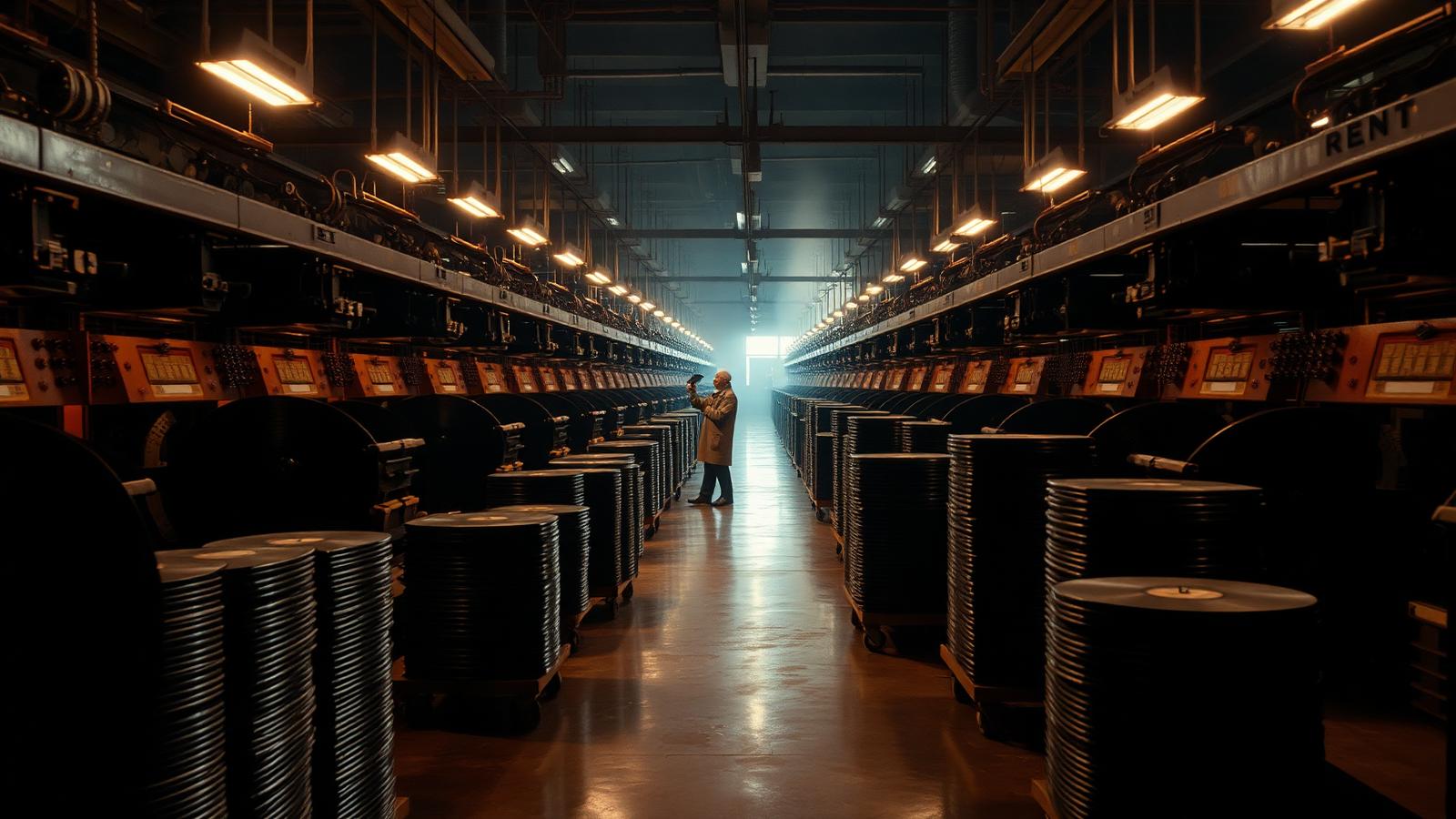
I started at EMI at twenty-one years old. Production Planning and Customer Liaison Manager. EMI Manufacturing and Distribution Services. Hayes, Middlesex. The year was 1981.
I left in 1989 at twenty-nine. Eight years. Punch cards to production systems. Telex to fax. Vinyl to CD. And somewhere in the middle of all of it, a crisis that nearly brought the whole operation down and a moment I have carried with me every year since.
What EMI actually was
Most people know EMI as a record label. The Beatles. Pink Floyd. David Bowie. Queen. Kate Bush. Cliff Richard. The most storied roster in British music history. The public saw the artists. Nobody talked about what sat behind them.
On the Hayes side of the Grand Union Canal, EMI Manufacturing and Distribution Services occupied one of the largest industrial sites in west London. Within that site the Yeading Brook divided the operation in two. Manufacturing on one side. Distribution on the other. Two different worlds. The manufacturing floor was noise, heat, the smell of warm vinyl, the rhythmic clunk of the presses. Distribution was movement, logistics, the organised chaos of getting product out to every British high street.
I lived on the manufacturing side. Close to 100 twelve-inch vinyl presses. Thirty-two seven-inch presses. At capacity the seven-inch machines produced between 2,500 and 3,000 units each per day. The twelve-inch could manage between 1,300 and 1,500. Hundreds of thousands of physical records, every single day.
One thing almost nobody outside the industry knew. EMI did not just press records for EMI artists. When a genuine hit landed anywhere in the British music industry, labels came to Hayes because nobody else had the capacity to handle real volume. CBS. WEA. Virgin. When something went to number one overnight, their own pressing facilities could not cope. They came to us. EMI was the music industry's emergency manufacturing backstop.
The world I walked into
In 1981 the operation ran on punch cards. Production planning meant physical cards, physical schedules, physical coordination between departments that could not talk to each other electronically because the systems to do that did not exist. Information moved at the speed of paper and people.
The customer liaison side of my role meant I sat between the manufacturing operation and the record labels. When a label needed 50,000 copies of a single by Friday and the presses were already at capacity, I was the person who figured out how to make it happen or had the conversation about why it could not. That tension, between what the creative side wanted and what the industrial operation could physically deliver, was the job.
Through the mid 1980s the technology around us shifted fast. Punch cards gave way to proper production systems. The telex gave way to the fax machine, which felt like witchcraft. By the end of my time at Hayes, mobile phones were appearing. Bricks. None of us knew we were watching the last great era of physical music.
The CD decision
In the mid 1980s the compact disc arrived. EMI's response was to establish CD pressing operations. The decision about where to put them was, for everyone at Hayes, the one that mattered most. They chose Swindon. Not Hayes. Not the site with the workforce, the expertise, the infrastructure, the decades of institutional knowledge. A new facility. A clean start. Away from the unions.
The Transport and General Workers Union and ACTSS were not happy. The Hayes workforce understood exactly what the Swindon decision meant. New technology, new site, their futures not part of the plan. The battles that followed were real and bitter. Production planning does not stop because the unions are unhappy. The presses still run. The orders still come in. The records still have to ship.
What Swindon taught me was something I have never forgotten. When organisations face technological change, the instinct is often to start fresh somewhere else rather than invest in the people who built what you already have. Sometimes that is the right call. It is rarely as clean as the decision-makers imagine. The human cost lands on the people who crossed the brook every day for their lunch.
The Polygram crisis
Then came the moment that changed everything for me personally. Polygram, one of the three largest record manufacturers in Britain, closed its pressing operation and outsourced its entire manufacturing volume to EMI. Overnight, Hayes went from two shifts to three. The scale of what we had to absorb was enormous.
And then the problem revealed itself. Polygram's component parts did not fit our machines. The music stampers, the metal parts used to press the records, had been grown in Polygram's electroplating baths to their own specifications. To run Polygram's catalogue on EMI's presses, the music had to be remastered from scratch. New lacquers cut. New metal parts grown in our own baths. Every title. Under time pressure. With three shifts running and orders backing up.
It was, without question, the most complex operational crisis I had faced. And the managers went quiet. I do not say that with bitterness. People respond to crisis differently. Some step forward. Some find reasons to be somewhere else.
I stepped forward. I took control of the remastering programme, the electroplating schedule, the press allocation, the shift planning and the customer communication. Every day was a new problem. Every day we solved it. Gradually the Polygram catalogue was remastered, regrown and pressed. The three-shift operation found its rhythm. The orders shipped.
Some time after, our Managing Director Ted Harris encountered my father, who also worked at EMI. He told him something I only heard second-hand, recounted with a pride on my father's face I have never forgotten. He said: if it had not been for your boy, this place would not have survived. I was in my mid twenties. That moment, seen through my father's eyes, told me what I was capable of.
What happened next
I left EMI in 1989. The Hayes site continued for some years. But the forces gathering around it were ones no pressing plant could outrun. The CD completed its conquest of the vinyl market through the late 1980s and early 1990s. Vinyl volumes collapsed. Then came the digital download. Then streaming. The entire physical model, vinyl and CD alike, was dismantled by technology that made the object irrelevant.
EMI itself was acquired by Terra Firma in 2007 for 2.4 billion pounds, a price that proved catastrophically optimistic. The debt was unsustainable. Universal Music Group acquired the recorded music business in 2012. One of the most storied names in music history was absorbed, broken up and distributed among the survivors. The Hayes site is gone. The presses are gone. The Yeading Brook still runs, but there is no manufacturing operation on either bank.
What EMI teaches
Scale is not a moat. At its peak Hayes had capacity nobody else could match. That capacity felt like an advantage. It was also a trap. The investment required to maintain it, the workforce required to run it, all of it became a liability when the market shifted. Capacity built for one era does not automatically transfer to the next. Scale in the wrong direction is just a bigger hole.
Technology waits for nobody. EMI saw the CD coming. The Swindon decision showed they understood the format shift was real. But seeing a change coming and responding to it well are different things. Companies that survive technology shifts are usually the ones that managed the human side of the transition without destroying what made them worth saving. EMI never fully solved that problem.
The people who step forward. When a genuine crisis lands, most organisations discover they have fewer people willing to step into it than they imagined. The complexity is real. The risk of failure is real. The instinct to wait for someone else to take the lead is human and understandable. The people who step forward anyway are the ones who define what an organisation actually is in the moments that matter.
I was twenty-five years old, standing on the manufacturing side of the Yeading Brook, looking at a problem that the people above me had decided not to own. I owned it. Not because I was certain it would work. Because someone had to. That is still, in my experience, the rarest and most valuable thing in any organisation. Not strategy. Not technology. Not brand. The person who steps forward when everyone else steps back.
References
- BPI (British Phonographic Industry) historical production data
- TGWU and ACTSS industrial records, mid 1980s
- EMI Group corporate history
- Personal operational experience, EMI Manufacturing and Distribution Services, Hayes, 1981 to 1989
By Michael Lennard Gnaedinger. © 2026 Gnaedinger Consultancy. All rights reserved.
If any of this sounds familiar.
I work with a small number of founders and CEOs each year. The conversation starts here.