
Two decades earlier in this series, GM built its dominance by competing on style instead of durability, deliberately. By the 1980s, that was exactly the gap Japanese manufacturers walked through. Toyota and Honda sold cars that simply lasted longer and broke less, at lower prices. GM's market share fell from 43.5 percent to 35.4 percent under CEO Roger Smith. Someone tried to warn the company early. Nobody wanted to hear it.
The warning GM literally banned from its own property
In the early 1980s, an efficiency researcher named Jim Harbour tried to show GM's executives exactly how much more efficient Japanese factories were, measured in labour hours per car. The gap was roughly double. GM's president at the time had Harbour barred from company property rather than sit with the number.
That's not a company that didn't know what was coming. That's a company that knew and actively didn't want to look at it.
Smith's answer: buy robots
Roger Smith did eventually try to respond. He just responded to the wrong problem. Between 1981 and the end of the decade, GM spent somewhere between 40 and 90 billion dollars, depending on how you count it, on automation, forming GMF Robotics with the Japanese manufacturer Fanuc and pursuing a genuine vision of lights-out factories that could run with almost no human workers at all.
It didn't work. Robots welded doors shut. Robots painted each other instead of the cars. Automated plants that were supposed to run at full efficiency limped along at roughly half capacity, tripped up by constant glitches. By the end of the decade, GM was producing 11.7 cars per employee. Toyota was producing 57.7.
The answer was already running, a few miles away, for a fraction of the cost
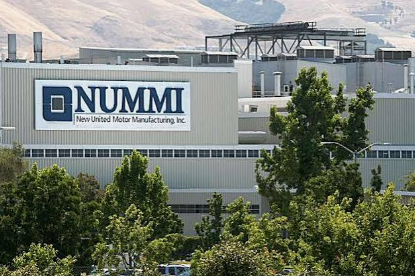
In 1984, Smith also agreed to something much smaller: a joint venture with Toyota called NUMMI, reopening an old GM plant in Fremont, California, using largely the same equipment and many of the same UAW workers from a factory that had previously been considered one of the worst in the entire company.
NUMMI became one of the most productive, highest quality plants in North America almost immediately, and new robots had nothing to do with it. Toyota brought its actual management system, what MIT researchers would later call lean production, and applied it to the same people and the same building GM had already been running for years.
GM had its answer sitting right there. Executives could walk the floor and watch it work. The lesson required admitting the problem was how the company managed people and processes, not what machines it owned, and that admission cost nothing close to 90 billion dollars.
What actually happened with that lesson
GM sent managers through NUMMI to study it. Some of them genuinely learned something. Almost none of them were able to bring that knowledge back and change how GM's core business actually operated. The company ran two experiments in parallel that decade, one that failed expensively and one that succeeded cheaply, and somehow still moved slower on the cheap, working answer than on the expensive, broken one.
What this decade actually teaches
When a competitor is beating you, the instinct is to out-spend them on technology. Sometimes that's correct. Here it wasn't. The actual advantage sitting on the other side of the table was cultural and organisational, not mechanical, and no amount of capital expenditure was ever going to buy GM out of that gap.
The 90 billion dollars wasn't even the most expensive mistake in this story. Having the real answer running successfully inside the company's own building, and still not moving fast enough to spread it before the market moved on without them, cost far more.
References
- Wikipedia
- Grokipedia
- IndustryWeek
- LeanBlog
- Imprimis (Hillsdale College)
By Michael Lennard Gnaedinger. © 2026 Gnaedinger Consultancy. All rights reserved.
If any of this sounds familiar.
I work with a small number of founders and CEOs each year. The conversation starts here.