
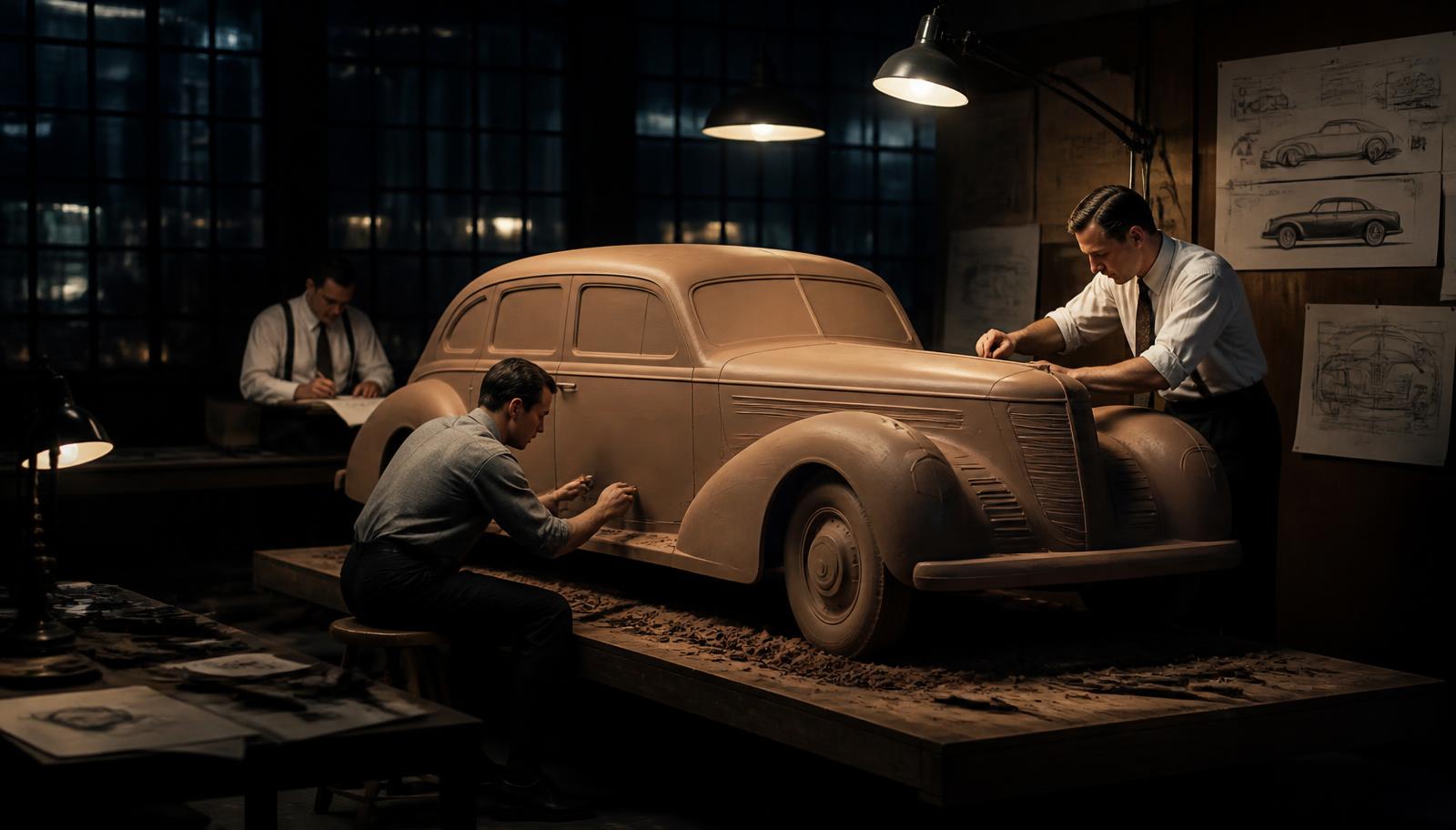
By 1955, General Motors was pulling in 9.8 billion dollars a year, roughly double the revenue of the next largest company on earth, and its profits ran about 50 percent higher again than each of its closest rivals. Nothing else in the world came close. The decision that built that gap came down to a designer, not a better engine or a cheaper price.
The problem Sloan actually solved
By the mid 1920s, the American car market had a saturation problem. Most people who wanted a car already had one, and Ford's stripped-down, unchanging Model T wasn't built to make anyone want a second. Alfred Sloan, running General Motors, realised the real opportunity was making people unhappy with the car they'd already bought, not building a better one.
Sloan hired Harley Earl, a Hollywood coachbuilder's son, to run a new department called Art and Color. Earl's job had nothing to do with engineering. His job was to redesign the look of every GM model every single year, whether the car underneath had meaningfully changed or not.
Dynamic obsolescence, refined to a science
Sloan called it dynamic obsolescence. Critics called it planned obsolescence, and the name stuck. The idea was simple and brutal. Bundle whatever real engineering improvements existed, automatic transmissions, power steering, better engines, into a single yearly reveal, wrapped in a new look designed to make last year's model feel dated by comparison.
By the 1950s, this had become the defining feature of the entire American auto industry. Tailfins grew taller every year through the decade, chrome got heavier, cars got longer and lower, culminating in the excess of the 1959 Cadillac Eldorado. Other manufacturers had no real choice but to follow. Restyling every year was expensive, and smaller competitors without GM's scale simply couldn't keep pace with the spending.
Why this actually worked as a strategy, not just a gimmick
Sloan wasn't gambling on genuine innovation every year, and he said as much. He considered real technical novelty risky. Restyling was cheaper and more predictable than invention, and it let GM get publicity value out of small incremental changes that would otherwise have gone unnoticed. The annual model year became a manufactured event, something the whole industry, and eventually the whole culture, organised itself around.
Combine that with GMAC, the financing arm that let customers buy now and pay over time while Ford still insisted on cash, and GM had built a machine that manufactured desire on a schedule and then handed you the loan to satisfy it.
The seed of the problem that showed up twenty years later
Here's the part worth sitting with. A strategy built entirely around styling, not durability, works brilliantly right up until a competitor shows up selling the thing you deliberately stopped competing on. When Japanese manufacturers entered the American market in the 1960s and 1970s with cars built to last rather than to look different every September, American manufacturers were forced to scramble and rebuild the durability muscle they'd spent thirty years neglecting.
GM didn't lose its grip in the 1950s. Every number in this piece shows the opposite. But the exact discipline that built the empire, competing on desire rather than durability, was quietly setting up the vulnerability that would cost the company dearly decades later. That's a story for a future piece in this series.
What this decade actually teaches
The most dominant strategy of a decade and the seed of the following decades' decline can be the exact same decision. Sloan didn't make a mistake in the 1950s. He made the correct call for that market, at that moment, and it built the most profitable industrial company on earth.
The real lesson is to notice, while you're still winning, which of your strengths you've deliberately chosen not to compete on, because eventually somebody else will, rather than assuming the strategy needs abandoning altogether.
References
- Wikipedia
- Scott Grundfor Company
- CarBuzz
- WFYI
- Archbridge Institute
- Petrolicious
- Ate Up With Motor
- Justapedia
By Michael Lennard Gnaedinger. © 2026 Gnaedinger Consultancy. All rights reserved.
If any of this sounds familiar.
I work with a small number of founders and CEOs each year. The conversation starts here.