
I resigned from EMI in 1989. Eight years. The Polygram crisis. The vinyl presses. The Yeading Brook. Ted Harris telling my father that without his boy the place would not have survived. All of it. Then a new General Manager arrived. Peter Hall. Flamboyant. Loved himself. Looked exactly like Dirty Den from EastEnders. And we all know what happened to Dirty Den. He and I did not see eye to eye. The professional version stops there. The honest version is that Peter Hall walked into an operation other people had built and spent his time making it about himself. I left.
Part one: the typewriter
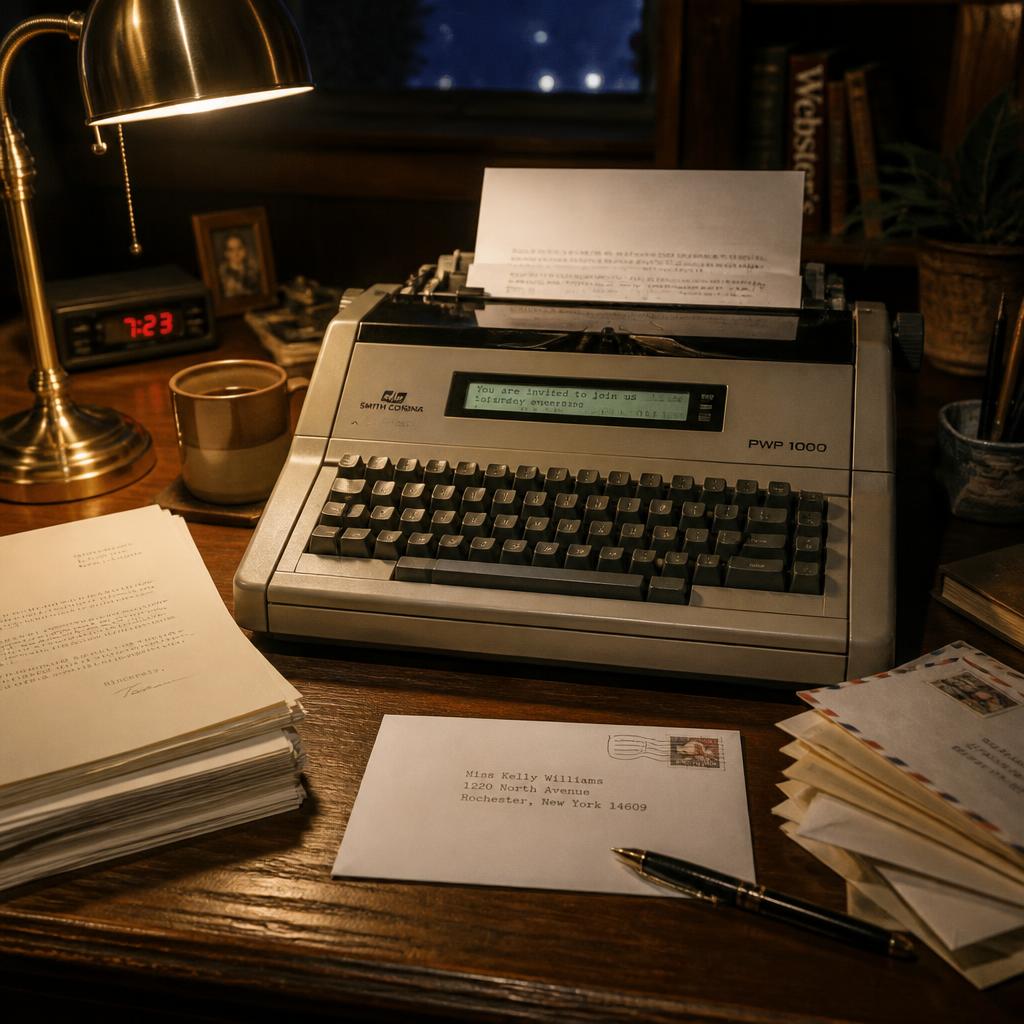
Before I flew out, I sat down at my Smith Corona typewriter. Not a computer. A typewriter. Though this one had a small innovation that felt, at the time, like the future: you could type two lines of text, read them on a tiny screen, and only then commit them to paper. No correction fluid required. No starting again. For someone about to type over a hundred individual letters, that two-line preview screen was everything.
I typed 107 letters. Each one addressed personally to the Managing Director of a local business. Each one saying the same thing in its own way: my name is Michael Smith, I have just left a senior role at EMI, I specialise in change management and operational turnaround, and I will be available in approximately 28 days. I stuffed and stamped 107 envelopes. Walked to the post box and deposited every one of them. Then I flew to Acapulco with my girlfriend.
Part two: the beach
Acapulco in 1989 was exactly what it sounds like. A month in the sun. Good food. No answering machine. No telex. No production schedules. No Peter Hall. My girlfriend and I had a brilliant time. Somewhere in the back of my mind, 107 letters were making their way through the British postal system to 107 managing directors who had no idea I existed yet. I did not spend the holiday worrying about the response rate. I had done what I could. The rest was out of my hands.
Part three: the door
We came back to a door I could not open. Not locked. Blocked. There was so much mail behind it that it had jammed against the frame. I pushed. I squeezed through the gap. I looked down at the pile on the floor. 70 replies. From 107 letters sent to managing directors, addressed by name, with no email, no LinkedIn, none of the tools people use today to do exactly this but worse: 70 replies in 28 days. A lot were thanks but no thanks. Fair enough. But 20 were positive. And 9 of them were asking me to get in touch for a conversation. I had not even unpacked.
Then I noticed the answering machine. Small device. Cassette tape inside. The light was flashing. I counted the flashes. More than thirty. I pressed play. Several messages in, a voice I recognised came out of the speaker. Rick Carter. Operations Director at Virgin Records. Virgin had been one of my manufacturing customers at EMI. I had pressed their records at Hayes for years. Rick knew exactly who I was and what I was capable of. What he said made my girlfriend look up from across the room.
"Hey Smithy you Wanker, it's Rick. You did not tell me you were leaving. Give me a call." My girlfriend said: does he always talk like that? I was already reaching for the phone.
Part four: Kensal Rise
Rick Carter's office was in Kensal Rise. I walked in with mixed feelings. I had always liked Rick. Direct, no nonsense, no gap between what he thought and what he said. But liking someone and working for them are different things. I sat down. He looked at me. Then he said: what do you think of Peter Hall? I paused. I had prepared for this. "Peter has his own style of management. He and I did not see eye to eye on a number of things." Rick nodded. "Really." "Yes." "Because Peter Hall told me you could not be trusted."
I sat with that for a moment. I had been trying to stay professional. Peter Hall had not extended me the same courtesy. "Right," I said. "I was trying to remain professional but I can see that's not how Peter wants it. The truth is Rick, the guy is a self-obsessed egotist. A complete dickhead." Rick burst out laughing. I burst out laughing. The tension in the room disappeared in about four seconds.
Then Rick leaned forward. "Polygram are messing up my distribution and I need you to get over there and sort it out." I said the only honest thing I could. "Rick, I know nothing about distribution." He waved his hand. "You sorted out that mess at EMI. This will be easy for you." He reached into his desk. Set of keys on the table. Saab 900 S. Then a phone. Motorola 8800. Then he told me to call him when I got to Chadwell Heath. That was the interview. No job description. No HR panel. No probation. Keys. Phone. Go. I picked them up and walked out.
Part five: Chadwell Heath
Virgin had moved distribution from EMI in Hayes to Polygram in Chadwell Heath. It was a disaster. Stock issues. Fulfilment problems. The kind of chaos that builds up when a distribution relationship breaks down and nobody with the right operational background has been sent in to diagnose it. Rick had sent the right person. I had spent eight years on the other side of this relationship. I knew how the records were made. I knew how the orders were supposed to flow. Distribution was a new job title. The skills underneath it were eight years old. I called Rick. I told him what I found. I told him what needed doing. He said get on with it. I got on with it. That was my start in distribution and logistics. The rest is history.
What this story actually teaches
The approved channels did not find Rick Carter. Rick found me. He had heard I had quit, tracked down my home number through a work colleague, and left his message on the tape before I had even landed back in the country. The typewriter found 9 conversations. Rick needed no letter. 107 letters. 70 replies. 9 serious conversations. 1 answering machine message that changed the direction of my career.
Every letter went to the Managing Director. Not HR. Not a recruitment contact. The person with the authority to say yes. I told them when I would be back. A deadline creates movement. It signals confidence. It says I am not waiting by the phone. I went to Acapulco. The month away was not a distraction. It was part of the signal. Someone who takes a month on a beach before their next role is not desperate. And Managing Directors notice desperation.
When Rick asked what I thought of Peter Hall, I tried diplomacy first. It did not land. So I told the truth. That was the moment Rick decided. Not the CV. Not the career history. The truth, told without flinching, in the right room. Skills travel further than job titles suggest. I told Rick I knew nothing about distribution. He did not care. He had watched me operate. He knew what was underneath. The Saab was a nice touch too.
References
- Personal experience, EMI Manufacturing and Distribution Services, 1981 to 1989
- Virgin Records Distribution Operations, Chadwell Heath, 1989 onwards
By Michael Lennard Gnaedinger. © 2026 Gnaedinger Consultancy. All rights reserved.
If any of this sounds familiar.
I work with a small number of founders and CEOs each year. The conversation starts here.