
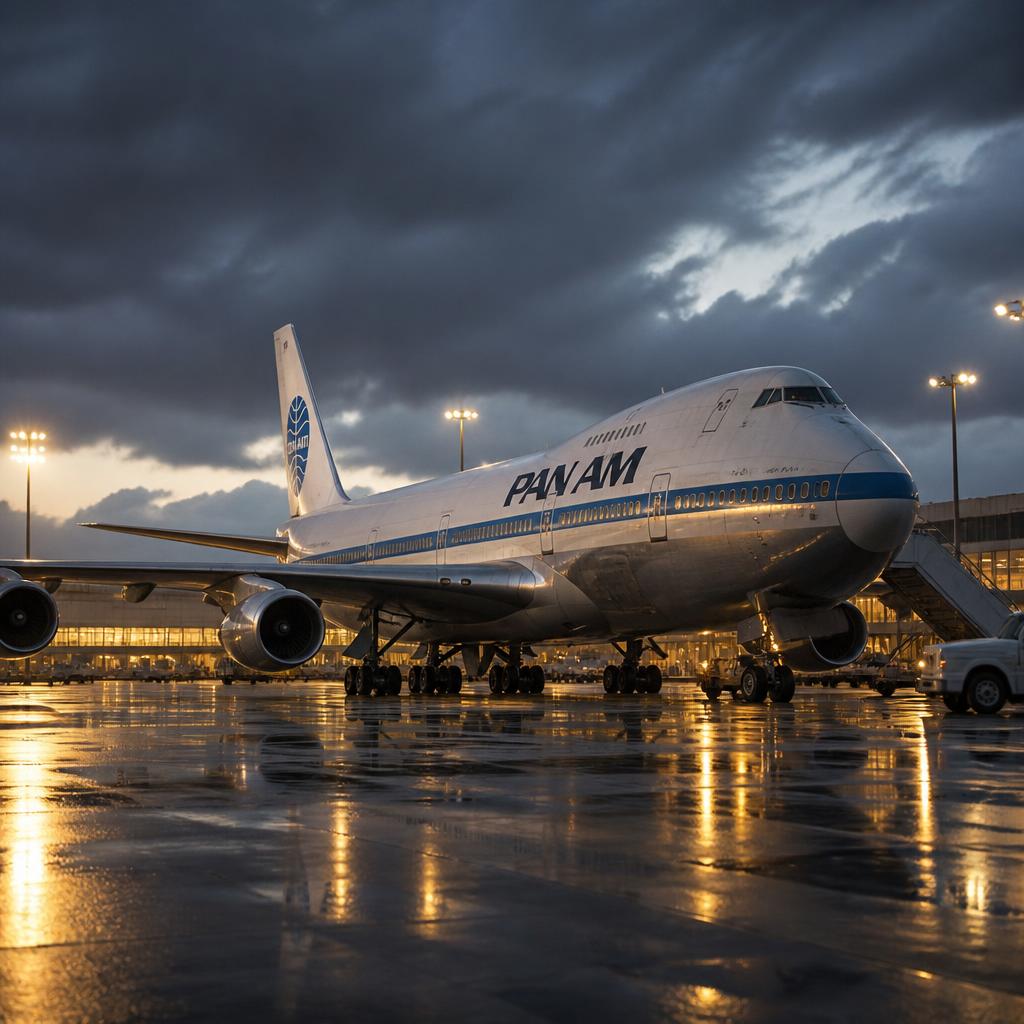
Sunday afternoons at Heathrow were sacred. Terminal 3. Before the retail sprawl. I was thirteen, notebook in hand, recording tail numbers. And on every visit my friends and I would summon the courage to walk up to the Pan Am check-in desk and ask, as politely as a nervous teenager could manage, whether the staff had any stickers or luggage tags they could spare. They always did. The women behind that desk were, in the eyes of a teenage boy in the 1970s, the most glamorous human beings on earth. That was Pan Am. Not an airline. A world.
It does not exist anymore. And the story of how it disappeared is one of the most instructive business failures of the twentieth century.
The making of a legend
Juan Trippe founded Pan American in 1927 and was not running an airline. He was building an empire. Yale man, political connections, a visionary's appetite for risk. Pan Am started with a mail contract between Key West and Havana. Within a decade it was flying the Pacific. By 1939 it was crossing the Atlantic. The Boeing 314 Clipper flying boats were the most luxurious aircraft ever built. Passengers dressed for dinner. Nobody else was doing this. Pan Am was not competing in a market. It was creating one.
The chosen instrument
The United States did not have a national airline. Pan Am filled the role. Route monopolies, government subsidies, political support for expansion. Trippe cultivated presidents and senators with the same energy he applied to aircraft manufacturers. It also created a dangerous dependency. Pan Am's identity became entangled with American power projection in a way that made it less a business and more an institution. Institutions, when the world changes, are often the last to notice.
The 747 bet
In 1966 Trippe ordered 25 Boeing 747s. At the time the 747 did not exist. He essentially co-funded a new class of aircraft. The 747 first flew commercially with Pan Am in January 1970. New York to London. 362 passengers. Nothing like it had ever flown before. It was a triumph. It was also the beginning of the end. The debt was staggering. Trippe bet that the 747 would democratise air travel, drive down fares, fill seats and service the debt. He was right about the democratisation. He was wrong about Pan Am being the one to profit from it.
Deregulation and the end of the protected world
In 1978 Jimmy Carter signed the Airline Deregulation Act. For Pan Am, the moment the floor disappeared. Southwest was already operating. Fares collapsed. Pan Am's costs were enormous. Its fleet was expensive. Its staff were unionised and well-paid. Its routes were predominantly international, where it still had advantages, but the lucrative domestic feeder routes were now open to competitors who could undercut it on price. The domestic network Pan Am needed, it did not have. The cost structure it carried, it could not shed.
The National Airlines acquisition
In 1980 Pan Am bought National for 437 million dollars. The logic was sound on paper. The execution was a disaster. Different cultures, different union agreements, different operating systems. Integration was brutal and expensive. The cost savings never materialised at anything like the anticipated scale. Pan Am paid a fortune to buy a domestic network, then spent years fighting the integration instead of flying the routes.
Selling the crown jewels
In 1981 the Pan Am Building in New York went. In 1985 the Pacific routes went to United for 750 million. The routes Trippe had pioneered. Sold to raise cash. Each sale bought time. Each sale also diminished what Pan Am was. A business that survives by selling its best assets is not recovering. It is dying slowly.
Lockerbie
On 21 December 1988 Pan Am Flight 103 departed Heathrow bound for New York. Over the Scottish town of Lockerbie a bomb in the forward cargo hold detonated. 259 people on board and 11 on the ground were killed. For Pan Am, a commercial catastrophe on top of the human one. Security failures were identified. Warnings had not been properly acted upon. Passengers who had a choice stopped choosing Pan Am. Corporate travel managers rerouted their bookings. The brand that had represented glamour and the romance of flight became associated in the public mind with the most horrifying security failure in commercial aviation history.
The Gulf War and the end
In 1990 Iraq invaded Kuwait. Transatlantic demand collapsed. For an airline with Pan Am's cost base and debt load, empty seats were an existential threat. In January 1991 Pan Am filed for bankruptcy protection. Delta bought the transatlantic routes, the Frankfurt hub and the shuttle for 1.4 billion. On 4 December 1991 Pan Am flew its last flight, Miami to Barbados. The airline was sixty-four years old. No government stepped in. No buyer saved it whole. The most famous airline brand in the world was allowed to simply stop.
What Pan Am teaches
The brand was not a marketing confection. It was earned. And it was completely insufficient to save the company. Underneath the brand, the business had fundamental structural problems that no amount of goodwill could fix. The brand outlasted the business model by about twenty years. It kept passengers loyal past the point where loyalty was rational. It kept staff proud past the point where the business deserved their pride. It kept politicians reluctant to let it fail past the point where saving it was possible.
The lesson that travels
Brands do not save businesses. They buy time. A powerful brand creates a halo around operational weakness that customers, investors, regulators and sometimes management itself cannot see past. The companies most at risk from this dynamic are often the ones with the strongest brands. The brand becomes the story the organisation tells itself. The gap between the story and the operational reality widens. And by the time the gap is undeniable, it is usually too late to close it.
Question for the network
In your organisation, is the brand a reflection of operational reality, or a substitute for it? Pan Am answered that question on 4 December 1991. The planes stopped. The brand lived on in nostalgia, in merchandise, in the memories of a generation that watched its 747s come in over Heathrow. That is not a business. That is a ghost.
References
- Robert Daley, An American Saga: Juan Trippe and His Pan Am Empire (1980)
- Barnaby Conrad III, Pan Am: An Aviation Legend (1999)
- US NTSB Lockerbie investigation records
- Pan Am bankruptcy filings, SDNY, 1991
By Michael Lennard Gnaedinger. © 2026 Gnaedinger Consultancy. All rights reserved.
If any of this sounds familiar.
I work with a small number of founders and CEOs each year. The conversation starts here.