
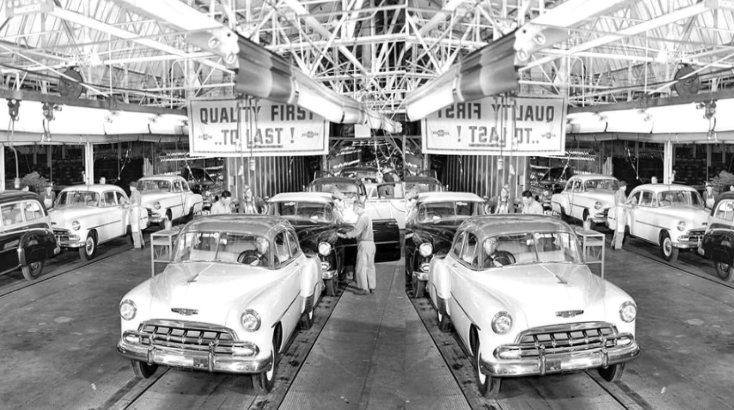
GM faced the same basic threat twice in this decade. Imports were eating into small car sales in 1968. The oil crisis gutted big car demand in 1973. Both times, GM had to move fast. Only one of those responses actually worked.
Twenty four months to beat Volkswagen
In 1968, GM president Ed Cole gave Chevrolet a mandate: build a small car good enough that nobody would ever buy a Beetle again, and do it in 24 months. The result was the Vega, developed at a genuinely automated new plant in Lordstown, Ohio, built to run at nearly double the normal production rate.
The car had real engineering ambition behind it. A lightweight aluminum engine block. Careful styling from the same studio that did the Corvette. Motor Trend named it Car of the Year in 1971. Underneath the ambition sat a mandate that made no sense: cut costs but don't cut anything else. Something always gives when you say that out loud.
What actually gave
The rust-proofing process didn't reach every panel on every car, because dipping bodies at that speed left gaps. The aluminum engine's cylinder walls weren't durable enough for real-world driving and emissions-mandated lean-burn conditions pushed combustion temperatures higher still. By 1972, six out of every seven Vegas built had an open recall. Owners rebuilding engines before 60,000 miles became common enough to be a running joke.
Ralph Nader's Center for Auto Safety, the organisation GM had effectively funded through the settlement in the last piece in this series, put out a public letter calling the Vega sloppily crafted and unsafe. GM was, in a very real sense, paying for its own criticism twice in the same decade.
Then the oil crisis hit, and GM did the opposite
The 1973 embargo punished exactly the big, thirsty cars that had defined GM for twenty years. This time, instead of a 24 month sprint, GM ran a phased, multi-year engineering programme. Starting with the 1977 full-size B and C platform cars, and continuing division by division and size class by size class through 1982, GM shed an average of 12 inches of length and 750 to 800 pounds of weight per car, while holding interior space almost constant.
GM was the first American manufacturer to get a downsized full-size lineup to market. Chrysler did the reverse, launching bigger, heavier cars right into the teeth of the oil crisis in 1974, and nearly went bankrupt by the end of the decade because of it.
Same company, same decade, same kind of pressure
Both projects existed because the market was moving fast and GM needed an answer. Both cars were engineering-heavy, genuinely inventive projects. What actually separated them was whether the calendar matched the complexity of the problem, not how ambitious the engineering was.
Twenty four months was enough time to design a good-looking small car. It wasn't enough time to mature a new aluminum alloy, validate a new rust-proofing process, and ramp a brand new automated plant, all at once. Five years, spread across a properly staged rollout, was enough time to re-engineer an entire size class of vehicle without giving up the interior room customers actually cared about.
What this decade actually teaches
Deadlines don't fail projects. Deadlines that don't match the actual complexity of the engineering fail projects. GM's leadership in 1968 wanted the Vega's ambition on a compact car's timeline. GM's leadership in 1977 wanted the downsizing programme's ambition on a timeline that respected how long real engineering validation takes.
Same company, same decade, the same competitive threat twice over. The only variable that changed was whether they gave the work enough time to actually be good, and that one variable decided which project became a case study in failure and which one became the industry standard everyone else copied.
References
- Wikipedia
- Hagerty
- Jalopnik
- SlashGear
- The Autopian
- CarBuzz
By Michael Lennard Gnaedinger. © 2026 Gnaedinger Consultancy. All rights reserved.
If any of this sounds familiar.
I work with a small number of founders and CEOs each year. The conversation starts here.