
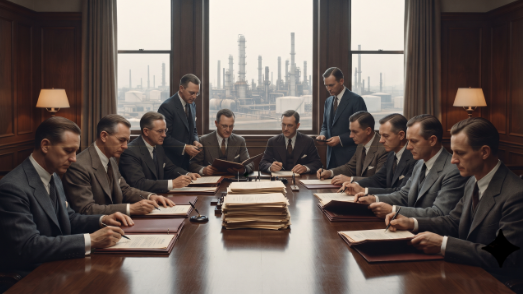
Walter Teagle, the same man who sat in that Scottish castle in 1928 carving up the world's oil markets, made a second deal a year later that would follow Standard Oil of New Jersey for the rest of the decade and into a war nobody had predicted yet.
A fear that made sense for about twelve months
In 1929, Teagle believed American oil reserves were running out. Coal could be converted into synthetic fuel using a hydrogenation process Germany's I.G. Farben had been developing, and Teagle wanted access to it. So in November 1929, Jersey Standard and Farben pooled their patents. Standard got the hydrogenation technology. Farben got a slice of the American chemical market and veto rights over licensing certain patents inside the United States, including the rubber technology it controlled.
It was called the Jasco agreement, and on paper it made complete sense. Standard built new hydrogenation plants at Bayway, Baton Rouge and Baytown. A joint company, Standard I.G., was set up with Jersey Standard holding 80 percent.
Then the reason for the deal disappeared
The East Texas oil field was discovered not long after the ink dried. Suddenly America wasn't running out of oil at all. It was sitting on one of the largest reserves ever found. The entire rationale for chasing German coal-to-oil technology evaporated within about a year.
Here's what didn't evaporate: the contract. Standard kept the patent-sharing arrangement in place through the rest of the 1930s, including Farben's veto power over licensing synthetic rubber technology inside the US. Nobody urgently needed synthetic rubber in 1931. That would change.
The bill came due after Pearl Harbor
By the time America entered the war, it needed enormous quantities of synthetic rubber, and Farben, exercising the veto it had held since 1929, had refused to let American companies produce it under reasonable terms. The country that had discovered an oil field the size of a small nation was desperately short of rubber because a wartime enemy still controlled the patent.
Justice Department antitrust chief Thurman Arnold spent months trying to break the arrangement apart. In March 1942, Standard signed a consent decree, released 2,000 patents royalty free, and paid a fine. Arnold testified to the Truman Committee that Standard had held up America's entire synthetic rubber program. Senator Harry Truman said the word treason from the floor of Congress. He didn't take it back.
What this decade actually teaches
This isn't a story about a company doing something reckless in the moment. Every step made sense when it happened. Fearing an oil shortage in 1929 was reasonable. Wanting hydrogenation technology was reasonable. Structuring the deal as an exclusive patent pool was standard practice for the era.
The failure was what happened after the original reason disappeared. Nobody went back and asked whether an agreement built around a 1929 fear still made sense once East Texas made that fear obsolete. The contract kept running on its own logic for over a decade, right up until national interest and contractual obligation pointed in opposite directions during a war.
Most bad decisions don't look bad on the day you make them. They look bad a decade later, when nobody remembers to check if the original reason is even still there.
References
- Time magazine archive
- IPBiz
- UCalgary Press (Manifold)
- The New Republic archive
By Michael Lennard Gnaedinger. © 2026 Gnaedinger Consultancy. All rights reserved.
If any of this sounds familiar.
I work with a small number of founders and CEOs each year. The conversation starts here.