
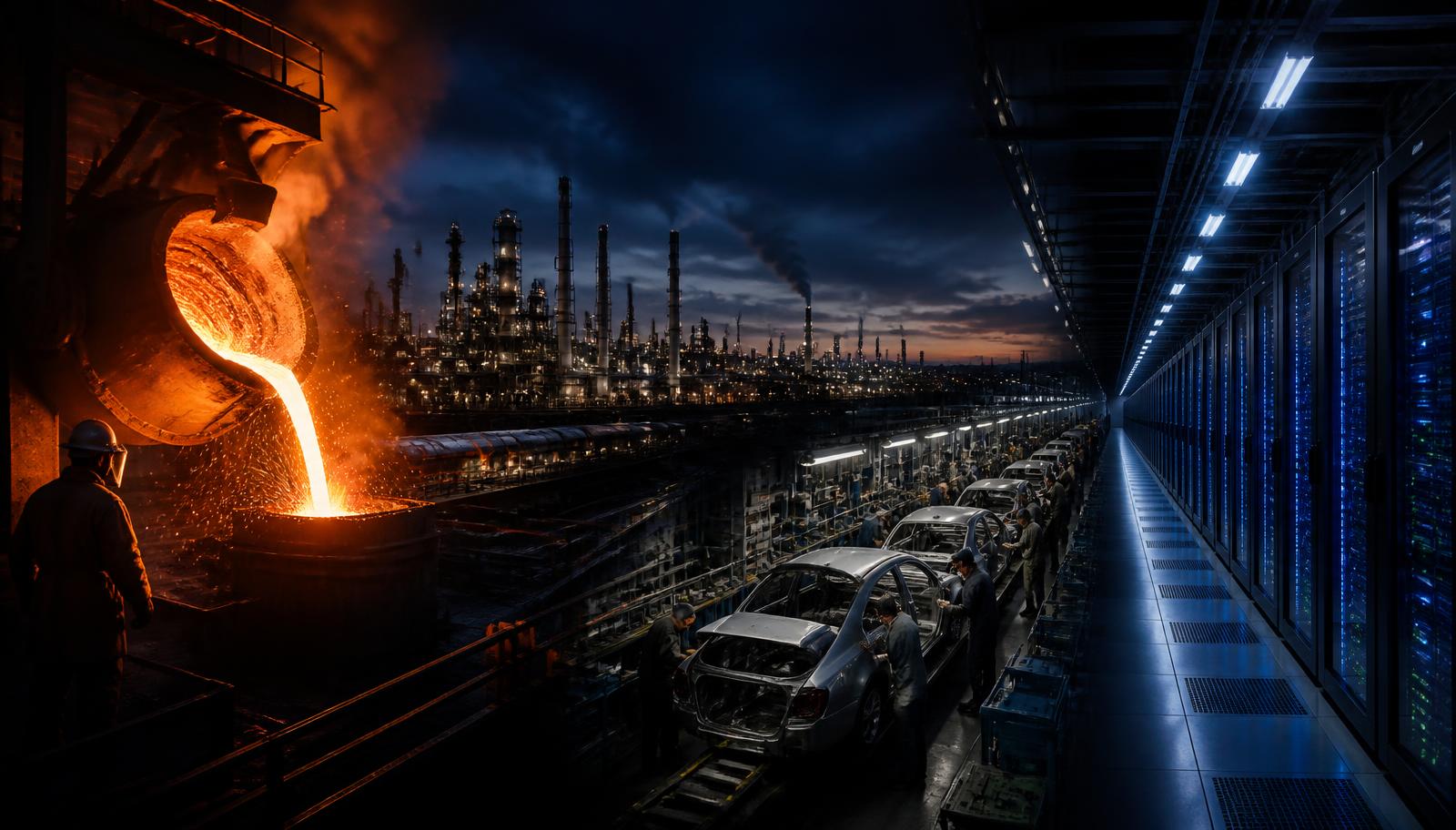
So I ranked it properly. Biggest company in the world by revenue, decade by decade, from 1900 to today, across every country and every industry, not just the American names that usually win these lists by default.
Here's the honest version, industry and country agnostic, ranked the same way throughout: total annual revenue, not profit, not market cap, not brand fame.
1900 to 1910: U.S. Steel, with an asterisk for the railroads
U.S. Steel was capitalised at a billion dollars in 1901, the first company ever valued that way, and it controlled two thirds of American steel output. But go back one generation and the Pennsylvania Railroad was already being called the largest business enterprise in the world by the 1870s, and its securities still made up over 10 percent of the entire US stock market around 1900. Companies weren't required to report sales until the 1930s, so anyone who tells you they know the exact global revenue ranking for this decade is guessing. U.S. Steel is the best documented answer. It isn't the only defensible one.
1911 to 1920: Royal Dutch Shell
Formed in 1907 specifically to take on Standard Oil, the Anglo-Dutch merger won. Shell became the world's largest oil producer by 1920. This is the one every American-only list quietly drops, because it breaks the story of steady US dominance.
1921 to 1930: Royal Dutch Shell
By the end of the decade Shell produced 11 percent of the world's crude oil and owned 10 percent of global tanker tonnage. Meanwhile GM was busy building the idea that a car could say something about you, and U.S. Steel was still enormous domestically. But globally, oil ran the decade, and Shell ran oil.
1931 to 1940: Standard Oil of New Jersey
The Depression hit everyone. Shell lost its Mexican assets to nationalisation in 1938. Jersey Standard, the biggest of the old Standard Oil pieces, came out on top through sheer reach and American demand recovering faster than most.
1941 to 1950: Standard Oil of New Jersey
The war ran on oil, and Jersey Standard supplied a huge share of it to the Allies. This is also when the "Seven Sisters," a mix of American and Anglo-Dutch companies, locked up the Middle East between them for the next thirty years.
1951 to 1960: General Motors
GM topped the first Fortune 500 in 1955 at 9.8 billion dollars, more than half the American car market. Europe and Japan were still rebuilding. Nothing else on earth was close.
1961 to 1970: General Motors
Same story, held for a full decade. Toyota existed. It wasn't yet in the conversation.
1971 to 1980: General Motors, briefly Exxon
Two oil shocks, 1973 and 1979, pushed Exxon's revenue past GM's in some years. First real sign the crown could leave Detroit.
1981 to 1990: General Motors
Held on through the decade by revenue, even as Japanese manufacturers ate into market share GM never fully won back. Toyota was closing the gap. It hadn't closed it yet.
1991 to 2000: General Motors
Last decade an industrial manufacturer held the global top spot on pure scale. Walmart and Exxon were closing fast.
2001 to 2010: ExxonMobil
The 1999 merger and a run of high oil prices built a company that dwarfed nearly everyone through most of this decade.
2011 to 2020: Walmart
Retail and logistics scale took the crown from energy. Sinopec came close, finishing second on the Global 500 more than once, but never actually got past Walmart. Saudi Aramco was the most profitable company on earth after its 2019 listing, but profit isn't revenue, and Walmart still had the bigger number.
2021 to present: Amazon
Amazon passed Walmart in 2026, closing 2025 at 716.9 billion dollars in revenue against Walmart's 713.2 billion. Only four companies have ever held the Fortune Global 500's top spot: General Motors, ExxonMobil, Walmart, Amazon. Worth saying plainly: Sinopec, Saudi Aramco, State Grid, CNPC and Shell all sit inside today's top ten too. China alone now fields more Global 500 companies than any other country on earth, including the US.
What actually changes
So: railroads and steel, then oil for thirty years split between an American trust and an Anglo-Dutch merger, then fifty years of American industrial and retail dominance, and now a genuinely contested top table between American tech-retail and Chinese and Gulf state energy giants.
The flag on top changes every few decades. What never changes is that whoever controls the era's defining resource, rail, then oil, then cars, then distribution, then cloud infrastructure, ends up running the table. Watch the resource. The company on top is just whoever got there first.
The series
This is the overview. Starting tomorrow I'm publishing a deep dive on each decade, one a day, thirteen in total. First up: U.S. Steel and the dinner party that built the first billion-dollar company on earth.
By Michael Lennard Gnaedinger. © 2026 Gnaedinger Consultancy. All rights reserved.
If any of this sounds familiar.
I work with a small number of founders and CEOs each year. The conversation starts here.