The Observation
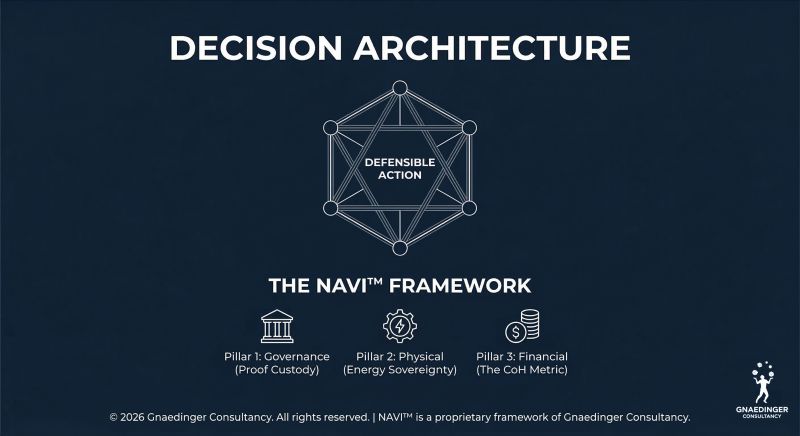
In 2026, the supply chain landscape has transitioned from a challenge of logistics to a challenge of sovereignty. As we navigate a NAVI™ world (Non-linear, Accelerated, Volatile, and Interconnected), the traditional reliance on simple digital twins has become a high-resolution form of fragility.
The Analysis
Leading firms are leveraging digital twins to build robust network simulations. However, as Ricardo Manuel Machado Ferreira recently noted, even the most advanced simulation remains a high-resolution form of fragility without execution governance. This is why I developed the NAVI™ Framework, to move beyond what if and into defensible architecture.
The Tactical Step
Supply chain leaders must prioritize partners that deliver practical AI applications and scenario modeling that can remain defensible when the system stops cooperating. To assist this transition, I am releasing the NAVI™ Decision Architecture Audit.
Full Audit: https://lnkd.in/gU5nRd9A
Question for the network
As we shift from advisory to execution, what governance structures are you implementing to ensure your simulations translate into action this year?
References
- NAVI™ is a proprietary framework of Gnaedinger Consultancy.
By Michael Lennard Gnaedinger. © 2026 Gnaedinger Consultancy. All rights reserved.
If any of this sounds familiar.
I work with a small number of founders and CEOs each year. The conversation starts here.