
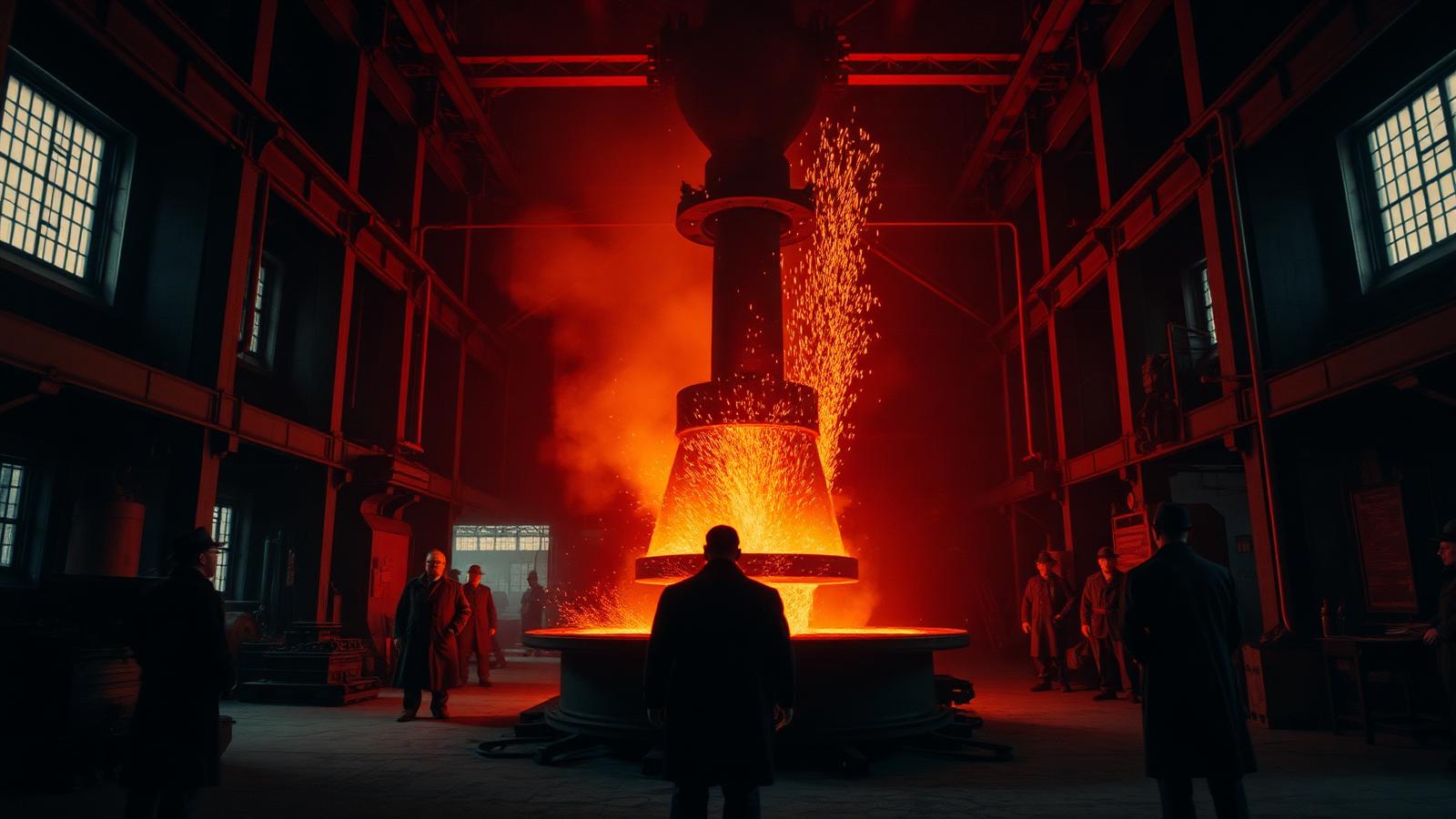
I previously published an overview piece ranking the biggest company in the world by revenue, decade by decade, from 1900 to today. This is article 1 of a 13 part series digging into each one properly.
A steel executive throws a dinner party. Nothing unusual about that in 1900. Except this dinner ends with the largest corporate merger anyone has ever attempted, and a company worth more than 4 percent of the entire US economy walks out the other side.
That is how U.S. Steel got built. Not in a boardroom. At a dinner table.
In December 1900, Charles Schwab, president of Carnegie Steel, was the guest of honour at a University Club dinner in New York. He was not especially well known outside the steel world. J.P. Morgan happened to be seated next to him. Schwab spent the evening describing his vision for a fully integrated steel industry, one company controlling ore, transport, mills and finished product, run efficiently enough to cut costs and still raise wages.
Morgan listened. A few weeks later he summoned Carnegie and asked what it would take to buy him out. Carnegie scribbled a number on a piece of paper: 480 million dollars. Morgan looked at it and said, I accept this price. The two men met once more, for fifteen minutes, to shake hands.
By March 1901, U.S. Steel existed. Capitalised at 1.4 billion dollars, the first billion-dollar company in history, controlling roughly two thirds of American steel production. For scale: the entire US federal government spent 517 million dollars that year. One company was now worth nearly three times the government's annual budget.
This is the part every retelling gets excited about. Fewer people talk about what happened next, which is the more useful story.
Why Gary chose stability over growth
Elbert Gary, the corporation's chairman, was nothing like Carnegie. Carnegie had built his fortune by cutting prices ruthlessly, selling steel near cost and grinding competitors out of business through sheer volume. Gary thought that approach was reckless. He called competition immoral and unprofitable, which is a genuinely strange thing for the head of America's largest industrial company to say out loud, and he meant it.
So Gary did something different. Starting in 1907, he began hosting his own dinners, regular meetings with the heads of every major steel producer, where prices were openly discussed and agreed. They became known as the Gary dinners. Instead of competing U.S. Steel's rivals out of existence, Gary chose to stabilise the whole industry around prices that kept everyone comfortable, including U.S. Steel.
It worked, for a while. The wild price swings that had defined steel in the 1890s calmed down. Profits stayed healthy. And it kept U.S. Steel just far enough from outright monopolistic behaviour that when the federal government sued in 1911, arguing the company violated the Sherman Antitrust Act, the case dragged on for a decade and the Supreme Court ultimately sided with U.S. Steel in 1920. Size alone, the Court ruled, was not a crime. Cooperative pricing among reasonable competitors, apparently, was not either.
Gary had built a company that was too careful to get broken up. That was the win.
The cost nobody priced in at the time
Here is what the price stability strategy actually did. By choosing not to compete aggressively on price, and by choosing not to reinvest as fast as a hungrier company might have, U.S. Steel's market share dropped from around 66 percent in 1901 to 50 percent by 1911. It kept falling for decades after that, down to roughly a third of the market by the 1930s and 40s.
Bethlehem Steel, run by none other than Charles Schwab after he left U.S. Steel in 1903, moved faster on new technology and specialised aggressively in armour and ordnance. It became the second largest steel producer in the country within a decade, eating share that Gary's careful, cooperative U.S. Steel simply let go.
This is the trade Gary made, whether he framed it this way or not. Stability over growth. Legal safety over market dominance. He avoided the breakup that took down Standard Oil in 1911. He also handed the next fifty years of market share erosion to more aggressive competitors, one point at a time.
The lesson for anyone running a company today
Being the biggest does not mean you have to keep acting biggest. Gary chose caution once the company reached the top, and that caution kept U.S. Steel alive and legally untouchable for over a century. Nippon Steel finally acquired it in 2025.
But caution has a cost, and it compounds quietly. Nobody notices a percentage point of market share disappearing in any single year. They notice it fifty years later when the company that used to define an entire industry is being bought by a foreign competitor.
Question for the network
If you are running a market leader right now, is the thing that made you big still the thing keeping you there? For U.S. Steel, those were two different things almost from day one.
By Michael Lennard Gnaedinger. © 2026 Gnaedinger Consultancy. All rights reserved.
If any of this sounds familiar.
I work with a small number of founders and CEOs each year. The conversation starts here.