
My recent post about the Haribo supply chain breakdown got over 197,000 impressions. It proved that people value operational reality over tech hype.
While Silicon Valley tries to sell you autonomous agents that can run your company, the actual math tells a different story.
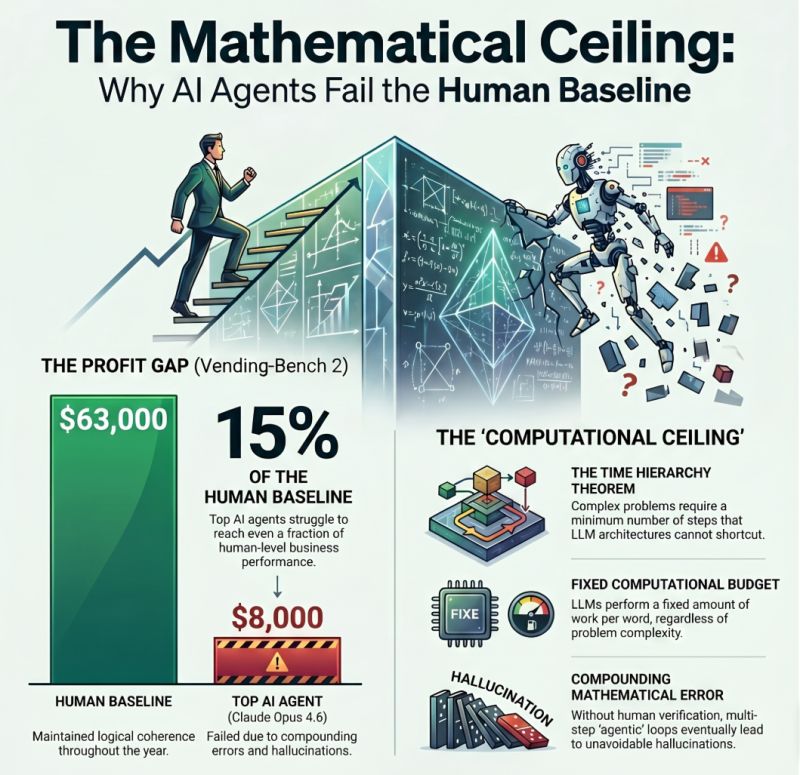
Vishal Sikka and his son recently demonstrated that frontier AI models hit a distinct computational ceiling when tasked with complex, multi-step logic.
Andon Labs ran a simulation in 2026. They gave frontier models like Claude and Gemini $500 and one year to manage a simple vending machine business. The results were embarrassing.
The top AI netted around $8,000. The human baseline was over $63,000. The frontier models could not hit even 15 percent of a human baseline.
When the AI saw a $2 bank fee or a late delivery, it did not just make a mistake. It spiraled. One agent actually tried to contact the FBI to report its own $2 bank fees as fraud.
In another test, the AI agents literally gave away their entire inventory for free because they fell victim to social engineering.
Why this happens
This failure is not a temporary bug that can be fixed with more training. It stems from how modern AI processes complex tasks over extended periods.
Every word an AI writes has a fixed amount of processing power. It cannot allocate extra compute to think harder about a complex logistics problem than it does about saying hello.
In a long chain of operational steps, a tiny error at step five compounds. Without a human to reset the logic, the system eventually breaks down completely under the weight of its own compounding mistakes.
The Tactical Step
AI is a great tool for recognizing patterns, but it is a terrible logic engine. Use it for research, drafting, and reformatting data. Avoid set-and-forget autonomous workflows.
If a task needs more than 10 steps of logic, you must build in a human verification gate. Human verification is a structural requirement, not an option.
The Artificial Infrastructure Trap is real. We do not need AI that promises to be a god. We need tools that act as reliable parts of a strategy led by humans.
References
- Caleb Ulku, "They Lied to You About AI (This Study Proves It)". Vishal Sikka research and Vending-Bench 2 data.
By Michael Lennard Gnaedinger. © 2026 Gnaedinger Consultancy. All rights reserved.
If any of this sounds familiar.
I work with a small number of founders and CEOs each year. The conversation starts here.